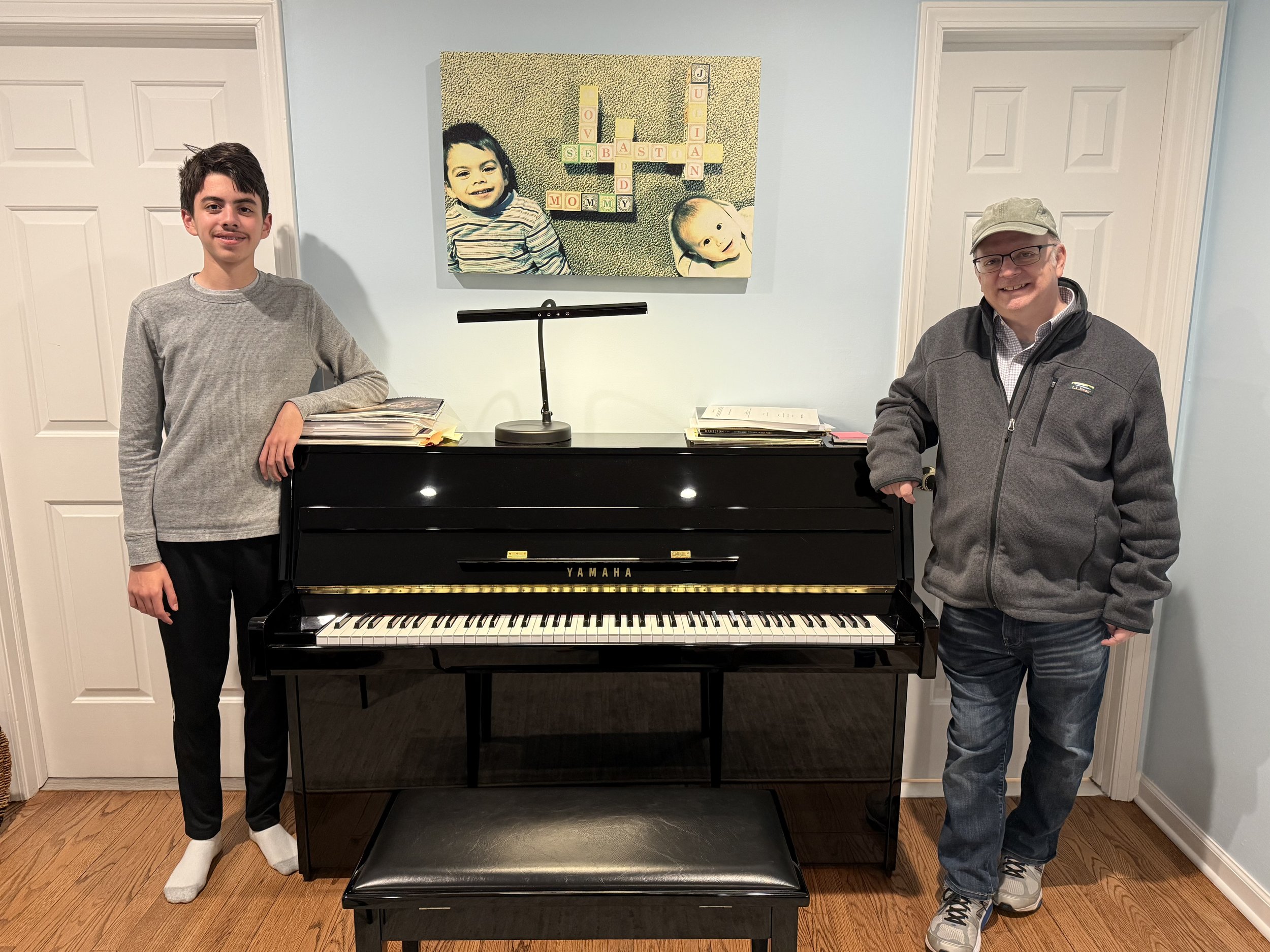
Sebastian is a multi-talented musician who is just beginning his high school career. In addition to studying piano, he plays drums in a rock band and plays saxophone in band.
Lighter Fare for the Summer Months
Once summer arrives, we put aside the heavier music for songs that are lighter…popular songs, ragtime, Mozart. Some of the summer songs are Dizzy Fingers, Paragon Rag, 80s Popular, and Broadway shows,
How Music Changes Your Brain
This is from composer/researcher Julie Giroux.
Music doesn't just make you feel different, it changes your brain.
Neuroscientists have found that playing or even listening to music activates more areas of the brain than almost any other human activity. Every time you practice, sing, or tap along to a rhythm, your brain builds new neural connections. And it's not limited to sound.
Music strengthens the same circuits that control focus, memory, emotion, language, and even motor skills. That's why musicians often have faster problem-solving skills, sharper memory, and better emotional regulation.
In kids, music literally shapes how the brain grows.
It builds stronger pathways between the left and right hemispheres, the same bridge used for creativity and logic.
In adults, it protects against cognitive decline.
Studies show that older musicians maintain better memory and focus than non-musicians.
Even passive listening can trigger neuroplasticity, the brain's ability to rewire itself.
In hospitals, music isn't just therapy. It's medicine.
Stroke and brain injury patients who receive rhythmic or melodic therapy often recover speech and coordination faster.
So next time you play, sing, or even hum along, remember this, you're not wasting time.
You're literally building a stronger, more connected brain. Your playlist might be doing more for your mind than your todo list ever could.
Passion builds intelligence.
Verified Sources (used for reference):
• Harvard Medical School
• National Institutes of Health (NIH)
• Journal of Neuroscience
• American Psychological Association (APA)
• Nature Reviews Neuroscience
• Frontiers in Human Neuroscience
• Stanford University School of Medicine
Making Remote/Hybrid Lessons Work for Middle and High School Students
For my Fairfield County students in middle school and high school, I begin with in-person lessons to get to know the students [and the student families to get to know me].
Following several months, we can consider a mix of online and in-person classes. I definitely can say that remote lessons work!!! Nonetheless, you can continue with in-person lessons.
Preparing for the remote lesson:
1: Decide on using iPad, laptop, or iPhone.
2: Decide if FaceTime or Zoom works better for you.
3. Position camera so I can see the hands and the music.
4. I will send a link for Zoom lessons. I will call you for FaceTime lessons.
5. After the lesson, I will text you the details of the pieces you will play during the week.
6. We conclude the lesson with friendly conversation!
November = Starting Holiday Songs
For intermediate students, I highly recommend a book called Carols By Candlelight by Jeanine Yeager. For the younger years, I enjoy using the Faber Christmas series. Available on sheetmusicplus.com and amazon.com
Akira, One of My Favorite Pianimals
Akira’s piano family was surprised that Akira took to me….apparently, she barks and growls at most anyone else!

Kell P.
Kell is now a professor in his own right. He studied with me for five years, and he reached an early advanced level by the time he graduated. Kell continues to play to this day.

Kell P in 2015
Laszlo B.
From an early age, Laz has taken on music projects far beyond the traditional repertory. He music directs, he produces, and he now leaves for college. Laz definitely will find music and theater communities that are eager to collaborate with him!

Sebastian M.
Sebastian has taken lessons with me for six years. He practices so diligently, and we still meet once a week while he is at college. His most recent accomplishment is learning the entire of Debussy’s Suite Bergamasque, a piece with four movements, the most well-known of which is Clair De Lune.

Sebastian, after completing a performance at his grandmother’s assisted living community.
Matthew C.
Matt studied piano with me for 6 years, supplementing modern classical and jazz by playing with a rock band. A gifted and dedicated student who explores everything from Baroque Music [Bach and Scarlatti] to full-on modern [Ligeti and Glass].

Matt has now graduated from college, and he continues to make music a significant part of his life!